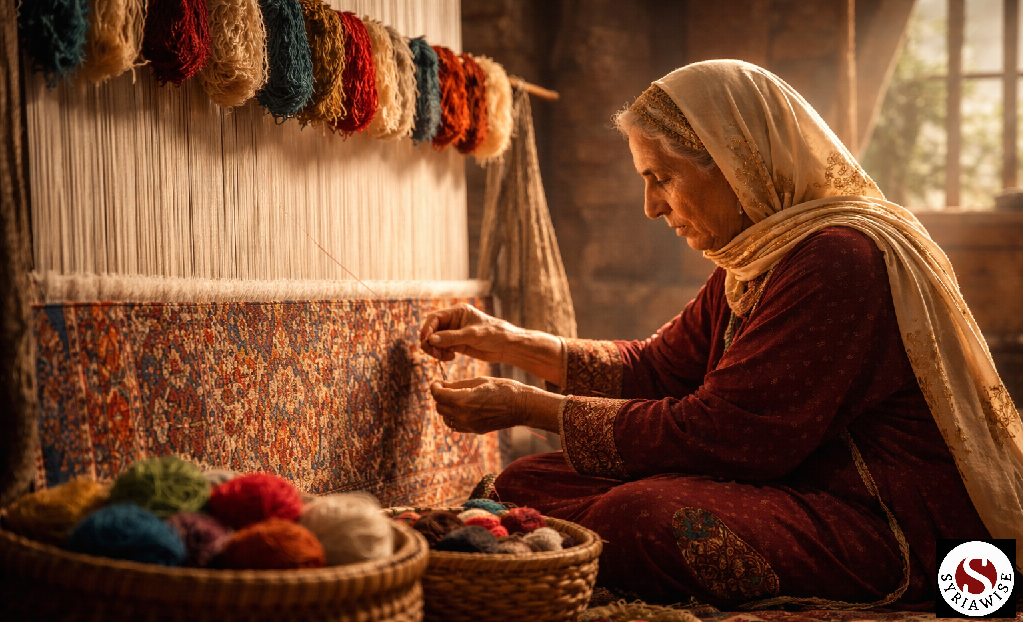
There was once a foolish woman from Mecca. She and her maidens would spin from morning until noon, and then she would order them to unravel what they had woven—a practice she repeated every day. Her folly was immortalized in the Holy Quran in the form of the following injunction: “And do not be like the one who undid her weaving after it was firmly woven” (16: 92). God set forth this example for the believers, who knew the woman, to warn them against breaking covenants once they have been firmly established.
In contrast, Homer’s Odyssey celebrates a woman, who did the same thing. Penelope would unravel by night what she wove by day, and she continued this for three years, awaiting her husband Odysseus, king of Ithaca, who had been absent for twenty years—ten in the Trojan War and ten in his adventures on the way back to his kingdom. During the last three years of his long absence, Penelope had many suitors, but she feigned that she would not remarry until she had completed weaving a burial robe for her beloved father-in-law. A maidservant, however, tattled and blew the cover on Penelope’s ruse. Fortunately, Odysseus arrived at the decisive moment and killed all the suitors of his faithful and noble wife. Thus, what Penelope did was a sign of loyalty and nobility, not of folly. Both the Quranic and Homeric images are strikingly vivid and rhetorically effective.
“Penelope unraveled by night not out of folly, but as a timeless act of loyalty and cunning patience.”
Dr. Musa Al-Halool
It is not surprising, therefore, that contemporary political discourse resorts to borrowing similar images from mythology to interpret reality, justify it, or even gloss over it. Such images confer upon everyday politics a false aura of historical wisdom or strategic depth. In recent years, for example, Iranian policy has often been likened to the weaving of the ancient Persian carpet—that is, a policy of long patience and quiet labor whose results only become visible with time. Yet to skeptic Arab minds, this image unwittingly evokes the Meccan woman’s folly.
For years, pro-Iranian apologists have been hypnotizing their audience with a now overused simile, comparing Iran to the famed Persian carpet weaver who patiently works for months, perhaps even years, to complete one fine carpet. It is an alluring comparison, but a misleading one: it leaps over reality and blinds the observer to the hidden workings of Iran’s regional policy. Through this analogy, we are carefully chaperoned to view the Iranian politician as a strategist of far-reaching vision—one who does not rush results but accepts gradual progress and tactical pauses in pursuit of distant goals. Yet this logical fallacy rests on a faulty analogy that has blinded both Iran and its apologists to its strategic folly. In truth, Iran has succeeded only in alienating its Arab neighbors, to the point that Israel has appeared, by comparison, almost like a meek lamb, prompting some Arab states to rush toward normalization with Israel—either out of fear of Iran or out of spite toward it.
Apart from its destructive role in Iraq, Lebanon, Syria, Yemen, and the Gaza Strip, Iran’s strategic myopia has become evident in its current confrontation with Israel and the United States. Instead of confining its response to the Israeli–American aggression, it has begun lashing out at all the Arab Gulf states, including traditional allies such as the Sultanate of Oman. Were any of these countries involved in the Israeli–American aggression against Iran? Not by a long shot.
And even if we were to concede, for the sake of argument, that Iran follows the policy of the carpet weaver, is it not also logical—according to market reasoning—to conclude that it sells its product to the first buyer or to the highest bidder? Could the tale of the carpet weaver not also indicate Iran’s proclivity to entangle both near and distant neighbors out of historical grudge and structural policy? And is it not permissible for us to assert, alongside the proponents of this analogy, that Iran’s carpet was hiding threads of treachery from its Arab neighbors that have only now been revealed?
Plato had warned against the pitfalls of analogy and the logical fallacies that arise from it. Yet this warning did not deter the French literary theorist Roland Barthes when he sought to convince readers of his theory of the “death of the author.” In 1968, Barthes compared a literary text to a piece of woven fabric, arguing that if you unravel the threads of that fabric, nothing remains. This, in Barthes’ view, was “proof” of the death of the author. And if we were to judge Iran’s apologists by their own flawed reasoning, alongside Barthes’ analogy, what would remain if we unraveled the weave of the Persian carpet? Would the weaver not also “die”? Our inferences could extend endlessly, far beyond what the proponents of this persisting metaphor ever claimed.
“Unravel the metaphor, and the strategy it hides may unravel as well.”
Dr. Musa Al-Halool
Those who work in the field of literature know that metaphors gradually become “dead” metaphors through overuse. In the case of Iran’s carpet, however, this metaphor risks becoming a lethal one. It was indeed recently put to the test during the first Israeli–American strike on Tehran, when the carpet faced the overwhelming force of technology that reduced it to tatters, sending more than forty weavers to the afterlife with a single push of a button. And who knows—perhaps time will reveal that among those weavers was a traitor, like Penelope’s maidservant, who sold the carpet and its makers for a given price.