
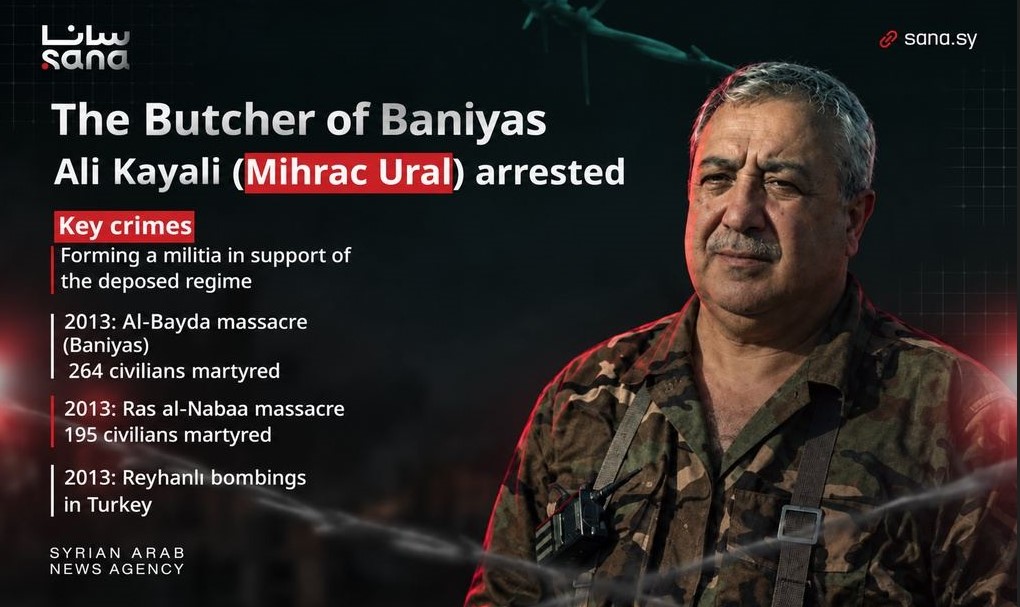
 Ali Kayali, also known as Mihraç Ural, pictured in a graphic announcing his arrest. Adapted from SANA.
The arrest of the criminal Mihraç Ural is an event of immense significance, not only for Syrians but also for international justice, given his status as the leader of a terrorist militia that committed documented crimes against innocent civilians with the aim of exterminating a specific community. The importance of his arrest is further underscored by the fact that he is a wanted fugitive in a neighboring country, Turkey. This renders the event both extraordinary and complex, as he holds dual Turkish and Syrian citizenship and committed his crimes across a geographical region spanning Syria, Lebanon, and Turkey.
Ural, also known as “Ali Kayali“, had been linked since the mid-1980s to a security and military apparatus established by the Hafez al-Assad regime amidst the conflict with Turkey that prevailed at the time. This apparatus involved sponsoring and founding both the Kurdistan Workers’ Party (PKK) and the “Syrian Resistance in the Sanjak of Alexandretta” organization. The objective was to undermine stability in southern Turkey and utilize these two groups as leverage within a complex web of tense relations between Damascus and Ankara throughout the Assad regime’s tenure, a dynamic that persisted until the signing of the famous Adana Agreement in October 1998. That agreement remains in effect to this day, as Ural’s arrest coincides with its twenty-eighth anniversary.
A History of Organized Criminality
Between 1980 and 2011, Kayali operated as an opponent of the Turkish authorities, exploiting the issue of the Sanjak of Alexandretta. However, he soon transformed into a terrorist whose activities spanned Lebanon, Syria, and Turkey, facilitated by direct and familial ties to the Assad family and, later, to Abdullah Öcalan, leader of the Kurdistan Workers’ Party (PKK), all under the supervision of Syrian State Security. While Ali Kayali had no clearly defined political record, his name emerged following the outbreak of the Syrian Revolution as the founder of what became known in late 2011 as the “Popular Front for the Liberation of the Sanjak of Alexandretta.” This move was a direct retaliation against Turkey’s principled stance in support of the Syrian Revolution.
Ali Kayali became a pivotal figure in the criminal network that began to emerge in late 2011 and 2012, coinciding with the Syrian regime’s decision to pursue a “security-based solution” and confront the Syrian uprising with armed force. This network comprised Ali Kayali’s militia, the Popular Front for the Liberation of Palestine, General Command (Ahmad Jibril’s faction), Hezbollah, and the National Defense Forces (NDF). The network’s criminality peaked with the massacres committed against civilians in Baniyas, specifically in the village of Al-Bayda and the Ras al-Nabaa neighborhood, under the direct command of Ali Kayali. At the same time, all other militias were actively participating in military operations within their respective areas of deployment, under the supervision of the Syrian army command and Syrian, Iranian, and later (starting in 2015) Russian intelligence.
“It is of utmost importance that Ali Kayali’s trial exposes this network of war criminals and reveals the former Assad regime’s security ties with Iran and the Qandil Mountains, as well as their respective roles in committing crimes against the Syrian people.”
Abdulrahman Matar
Ali Kayali remained an influential figure in the military and security confrontation against the Syrian people. His activities expanded to include close cooperation with the SDF; he was among the first to rush to their defense and support during the liberation of the Syrian Jazira region, arriving in the city of Tabqa mid-January last. This occurred shortly before the SDF was forced to withdraw from the area due to a popular uprising and the advance of the new Syrian government forces.
Dismantling the Assad Apparatus
The arrest of Ali Kayali represents a significant breakthrough against the remnants of the criminal Assad apparatus, elements operating across Syrian territory as sleeper cells attempting to obstruct the restoration of domestic security. These remnants retain communication channels and networks linking the groups within their fold or those supporting them; while these factions are small, they maintain the ability to operate covertly and deceptively. They continue to benefit from limited support provided by the remnants of Hezbollah and the Kurdistan Workers’ Party (PKK), both of which assist in harboring dozens of war criminals, shielding them, and smuggling them out of the country to evade justice.
“Ali Kayali’s arrest raises the question once again of whether his trial will lead to the exposure and apprehension of his accomplices.”
Abdulrahman Matar
It is of utmost importance that Ali Kayali’s trial exposes this network of war criminals and reveals the former Assad regime’s security ties with Iran and the Qandil Mountains, as well as their respective roles in committing crimes against the Syrian people. This is particularly crucial given the popular opposition in the Syrian Jazira region to the integration of certain SDF cadres into Syrian state institutions without implementing transitional justice mechanisms.
Ali Kayali’s arrest raises the question once again of whether his trial will lead to the exposure and apprehension of his accomplices. It also poses a fundamental question we had deliberately deferred: will he be treated as the Syrian citizen “Ali Kayyali” or as the Turkish national “Mihraç Ural”, a fugitive from Turkish justice? Furthermore, will he be extradited to Ankara under the Adana Agreement?
These are complex and difficult questions, weighed against the right of the Syrian victims of the Baniyas and Al-Bayda massacres to a public trial and just retribution. Ultimately, will his arrest be viewed as a valuable asset for justice, or merely as a major catch for the Syrian authorities?

