
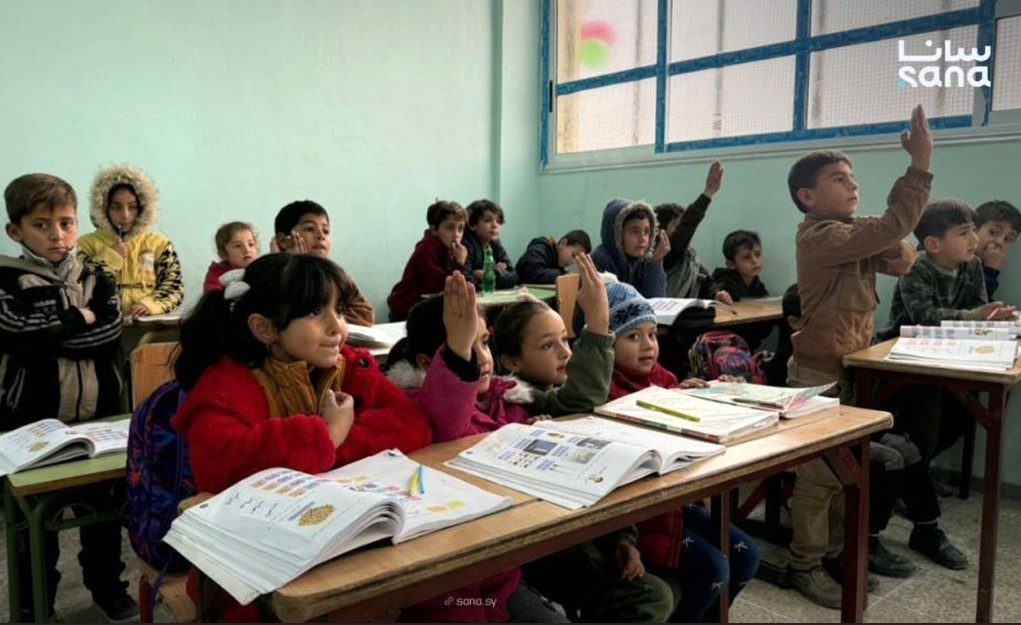
 Syrian schoolchildren participate in a classroom lesson, with textbooks open on their desks. Photo: SANA.
From Baathist Doctrine to Jihadist Doctrine: When Education Becomes an Instrument of Authoritarian Rule
Syria’s education system is at the heart of a struggle over who shapes the country’s memory, values, and future. What is surprising about the Jolani-led authorities revising school curricula in accordance with a hardline jihadist ideology? Is this not an extension of a process the Assad regime began decades ago, when it targeted Syria’s education system to domesticate successive generations and manufacture a consciousness that served its survival in power? The slogans and ideologies have changed, but the objective remains the same: to turn schools from places where minds are developed into instruments for shaping them according to the wishes of those in power, and to make curricula a means of controlling Syrians’ memory, consciousness, and future.
Years ago, I wrote an article entitled “An Assad-Era School Subject Designed to Assassinate Syrian Memory,” examining the Assad regime’s attempt to introduce a school subject called The War on Syria. Its purpose was to present the regime’s version of the war it had waged against Syrians and to rewrite events in a way that absolved the perpetrators of crimes while holding the victims responsible for what had happened to them. Syrian children were supposed to learn that what had occurred was a global conspiracy against a “resistance and defiance” regime, rather than a popular revolution by people demanding freedom and dignity. They were to be taught that those who rose up against the authorities were the enemies of the nation, rather than those who opened fire on demonstrators, destroyed cities, and filled prisons with detainees.
This was a project to assassinate memory: to erase from students’ minds the images of barrel bombs, aircraft, chemical weapons, and torture, and replace them with a narrative glorifying the army and security services, concealing the regime’s responsibility for the devastation, and portraying its allies, from Iran to Russia, as friends who had come to protect Syria and its sovereignty. Meanwhile, their crimes, interventions, and interests were removed from the story, and everything that had happened was reduced to a foreign conspiracy carried out by treacherous agents within the country.
This was no incidental detail in the Assad regime’s policies. It was part of a political and educational formula the regime had worked to entrench since the 1970s: “the resister versus the conspirator against the nation.” In the regime’s narrative, the regime itself was the nation, and its opponents were its enemies. Whatever served its survival became an act of patriotism; whatever threatened its power became treason. Students were therefore not taught how to think about events or examine evidence. They were taught to repeat the official narrative and internalize it.
Today, we are witnessing what raises serious concerns about the recurrence of this logic in a different form. As I argue here, the Jolani-led authorities are moving toward revising curricula and directing education according to a hardline religious frame of reference. This shifts the conflict from the Baathist dichotomy of “resister versus conspirator” to a takfiri dichotomy of “believer versus infidel,” and to distinctions between what is halal and haram, permissible and forbidden, according to an interpretation the authorities seek to impose and extend throughout society.
The issue is not a debate about the religious heritage, nor an intellectual dispute over Ibn Taymiyyah or any other religious scholar. The issue is the use of religious authority in the service of a political project: selecting what serves the authorities’ vision and turning education into a means of producing a generation that sees the world through closed, rigid binaries, leaving no room for disagreement, pluralism, or equal citizenship. When children are taught that someone else is an infidel or deviant simply because they are different, and that whatever the authorities deem forbidden must be imposed on society, we are no longer dealing with education that develops the mind. We are witnessing ideological conditioning that risks turning difference itself into a reason for exclusion and hostility.
This raises an unavoidable question: Can any reasonable person really believe that Jabhat al-Nusra ceased to exist as an organization and a project simply because it changed its name or moved from one position to another within the structures of power? Had it not already imposed forms of education and discourse rooted in takfir in Idlib, before reaching Damascus, while raising banners declaring democracy forbidden and arresting and killing opponents who rejected its approach? If this trajectory was already known, why should the targeting of education today come as a surprise? Is it not natural to expect an authority emerging from that environment to reshape institutions and society according to its own worldview, unless it encounters clear and sustained societal opposition?
“The most dangerous aspect of this process is that authoritarianism does not always need prisons to ensure its continuation. It can begin in the classroom.”
Dr. Yahya Al-Aridi
The most dangerous aspect of this process is that authoritarianism does not always need prisons to ensure its continuation. It can begin in the classroom: with the book a child reads, the phrase a child memorizes, the history a child is prevented from learning, and the question a child is taught not to ask. The Assad regime wanted a generation that saw the authorities as the nation’s salvation and blamed their opponents for the devastation. The hardline jihadist project, by contrast, risks producing a generation that sees the world as a battlefield of binaries: believer and infidel, permissible and forbidden, loyalist deserving acceptance and dissenter deserving exclusion.
In both cases, the underlying result is the same: the narrowing of the space for free thought, the weakening of people’s ability to exercise independent judgment, and the transformation of the school into an extension of the ruler’s ideology. Yet the danger in the new experience is compounded when exclusionary ideas are presented as absolute religious judgments. Those who absorb them may come to regard any objection not as a rejection of their political exploitation, but as an attack on religion itself.
Nevertheless, what deserves our attention is not the conduct of the authorities alone. Authoritarianism always seeks to impose its own narrative; that is part of its nature. What truly warrants reflection is society’s silence in the face of a repetition of the same experience. Syrians endured decades of attempts to domesticate their minds and manufacture an official consciousness. They then paid a heavy price when the regime’s narrative collided with reality and with their own demands for freedom and dignity. How, then, can some of them now acquiesce in another attempt to subordinate education, as though the first experience had taught them nothing?
Even more troubling is the absence of clear opposition from broad sections of the teaching profession and from social institutions capable of defending children’s right to an education that opens their minds rather than closes them. Silence in such moments is not merely a personal position. When curricula are left in the hands of those who seek to use them as instruments of domination, that silence creates a vacuum they can fill as they please.
“It is a question of who has the right to shape the minds of Syrian children, which values they are to be guided by, and what kind of society is to be created.”
Dr. Yahya Al-Aridi
Where is the teacher who refuses to let the classroom become an instrument of ideological indoctrination? Where is the academic who understands that education does not belong to the ruler, nor is it a privilege the authorities may grant to those who agree with them? And where are the parents who understand that their children’s future does not end with a school certificate, but is also shaped by the values they learn and by their capacity to think, disagree, and live alongside others?
No less dangerous is the position of states that support this authority’s continued rule, or deal with its policies as though they were an internal matter confined to Syria’s borders. Turning education into a means of reproducing exclusionary thought threatens more than Syrians alone. Generations raised on takfir and the rejection of others may carry these ideas beyond the country’s borders. It is unwise to wait for the consequences to materialize before recognizing that our fears have become crises that are difficult to contain. Protecting society from extremism begins, in part, with protecting education and holding the authorities accountable for the curricula they impose and the effects they have on children’s minds.
The Assad experience demonstrated that a regime can impose its narrative on textbooks, but it cannot guarantee that truth will disappear from people’s lives. The reality Syrians experienced was larger than the curriculum, and the crimes the official narrative sought to conceal remained present in the memories of victims and their families. Yet the eventual exposure of falsification does not absolve anyone of the responsibility to confront it from the outset. Generations exposed to hatred and exclusion may pay the price long before they are able to recognize the falsehoods they have been taught.
“It is a struggle over the Syria that will remain after us, and over the right of its future generations to live as citizens rather than as hostages to the ruling authorities’ ideology.”
Dr. Yahya Al-Aridi
This, then, is not merely a matter of revising a textbook, deleting one chapter, or adding another. It is a question of who has the right to shape the minds of Syrian children, which values they are to be guided by, and what kind of society is to be created. Do we want an education that teaches generations to think critically and respect differences, or one that hands them ready-made answers about enemies, traitors, and infidels? Have Syrians escaped an authoritarianism that sought to monopolize patriotism only to find themselves facing an authority that seeks to monopolize religion and its interpretation, imposing its own definitions of right and wrong on society?
The most dangerous outcome for Syria would be for the names of those in power to change while the mechanisms of human subjugation remain intact: one system of indoctrination falls only to be replaced by another, and the slogans change while the attempt to confiscate people’s minds, memory, and future continues.
One day, the price of Syrian and international silence will be enormous. When the consequences of what is being planted in children’s minds today become visible, those who remained silent will not be able to excuse themselves by claiming that they did not know or that they were not the decision-makers. Education left in the hands of those who seek to use it to manufacture obedience and hatred is not an issue that can be postponed until tomorrow. It is a struggle over the Syria that will remain after us, and over the right of its future generations to live as citizens rather than as hostages to the ruling authorities’ ideology.
Assad tried to assassinate Syrian memory. Today, there is a growing danger that memory, thought, and conscience will be directed along another path, using different tools. Between these two experiences, the responsibility of Syrians remains the same: to allow no authority to seize control of their children’s minds or turn schools into factories for reproducing authoritarianism, whatever slogans that authority raises or religious or ideological foundations it invokes.


This is deeply unsettling. After everything Syrians have endured, it is shocking to think that their children could inherit another system that teaches obedience rather than independent thought. They deserve classrooms where questions are welcomed and differences respected. I hope Syria’s future will be brighter than the troubling picture described here.