
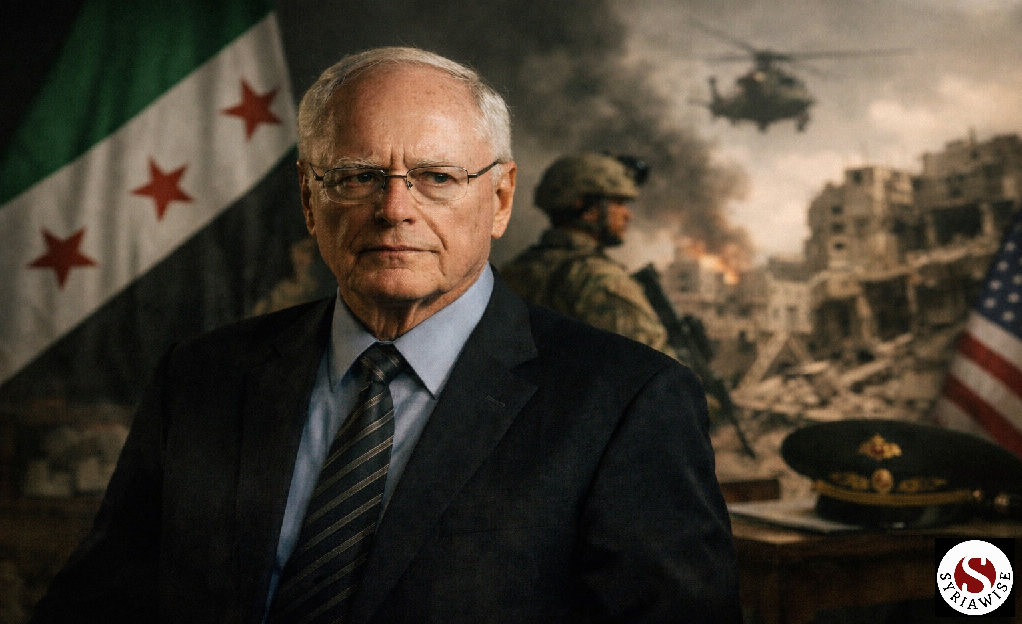
 James F. Jeffrey
On February 10, 2026, Ambassador James F. Jeffrey delivered testimony before the U.S. House Foreign Affairs Committee during a session dedicated to reviewing American policy toward Syria in the post-Assad phase. The testimony stands out not merely as a congressional record, but as a practical roadmap outlining Washington’s conditions for stability, reconstruction, and long-term engagement in Syria.
Ambassador James F. Jeffrey’s testimony before Congress, argues that Syria has become a central arena in efforts to secure lasting stability in the Middle East, especially following recent regional shifts and the weakening of Iranian influence. He contends that an opportunity now exists to rebuild a unified and stable Syrian state, provided there is coordinated international leadership led by the United States and avoidance of the competing foreign policies that fueled chaos during the civil war.
“Syria can be rebuilt as a unified, stable state, if guided by coordinated international leadership and clear U.S. policy toward Syria post-Assad.”
Dr. George Tuma
Core Objectives of U.S. Policy in Syria
Jeffrey outlines several pillars shaping U.S. strategy:
1. A Unified and Sovereign Syrian State
The United States seeks a Syria that is fully unified territorially and institutionally. Fragmentation, rival militias, and parallel authorities must give way to centralized governance capable of exercising sovereign authority across the country.
2. Responsive Governance and Minority Protection
A stable Syria must respond to the needs of all its citizens, including ethnic and religious minorities. Political inclusion, constitutional reform, and protection of civil rights are seen as prerequisites for internal stability.
3. Reconstruction Linked to Reform
Jeffrey stresses that reconstruction and international economic assistance should not be unconditional. Instead, aid must be directly tied to measurable progress in political reform, security restructuring, and respect for human rights. In this sense, reconstruction is framed not merely as technical recovery, but as leverage for reform.
4. Completing the Defeat of ISIS
Although ISIS has been territorially defeated, Jeffrey warns that the group remains a threat. Sustained counterterrorism cooperation, including coordination with Syrian partners, remains essential to prevent resurgence.
5. Countering Iran and Managing Russia
Jeffrey insists that Iran and its proxies must remain excluded from Syria—both physically and diplomatically. At the same time, Russia’s military presence complicates matters. While some regional actors do not prioritize Moscow’s removal, Washington draws clear red lines against Russian interference that undermines Syrian sovereignty or enables Iranian re-entry.
Historical Context: Syria as a Source of Regional Instability
Jeffrey reminds lawmakers that Syria has long played a destabilizing regional role, including wars with Israel, intervention in Lebanon, and facilitation of jihadist flows into Iraq. During the 2011–2024 civil war, Syria became the epicenter of one of the region’s most devastating conflicts, marked by the rise of ISIS, extensive Iranian and Russian intervention, massive civilian casualties, and one of the largest refugee crises in modern history.
Understanding this background is essential to grasp the stakes involved in post-war stabilization efforts.
“Syria’s past conflicts and foreign interventions underscore the high stakes of post-war stabilization efforts.”
Dr. George Tuma
Engagement with the New Authorities in Damascus
Jeffrey acknowledges that the United States had indirect dealings for years with leadership figures who emerged in Idlib prior to Assad’s fall, despite previous terrorist designations. In 2018, Washington allowed humanitarian assistance to continue flowing into Idlib and helped deter a large-scale offensive that could have displaced millions.
He argues that the current leadership in Damascus has taken preliminary steps to reduce sectarian tensions, curb extremist elements, and grant cultural and linguistic rights to Kurds. Although these reforms remain partial and incomplete, Jeffrey urges policymakers to evaluate them within the context of a country emerging from more than a decade of catastrophic war.
Kurdish Relations and the Future of the SDF
A key section of the testimony focuses on the Syrian Democratic Forces (SDF). Jeffrey reiterates that the U.S. partnership with the SDF was “temporary, tactical, and transactional,” designed primarily to defeat ISIS while maintaining relations with NATO ally Turkey.
With the fall of Assad, conditions have shifted. The integration of Kurdish-led forces into a unified Syrian state is now viewed as essential for long-term counterterrorism and internal security. Any sustainable arrangement should align with UN Security Council Resolution 2254, which called for ceasefire, constitutional reform, inclusive governance, refugee return, and respect for human rights.
“U.S. engagement with the SDF was tactical, but integrating Kurdish-led forces is now key to Syria’s long-term security and post-Assad stability.”
Dr. George Tuma
Governance and Local Administration
Jeffrey emphasizes that long-term stability requires citizen participation, local governance mechanisms, and meaningful protection of rights. Strengthening municipal authority and decentralization may help secure minority loyalty and reduce internal tensions.
He stresses that progress in governance reforms must be a prerequisite for substantial reconstruction funding, highlighting how U.S. policy toward Syria post-Assad links aid to accountable, inclusive local governance.
Regional Diplomacy: Israel, Turkey, and Broader Stability
Jeffrey proposes the pursuit of security arrangements between Syria and Israel, including limitations on militarization near borders, phased withdrawals, and communication channels short of full diplomatic recognition. Such steps could ease tensions and contribute to broader regional stabilization.
He also notes that the weakening of Iran has created direct proximity between Turkey and Israel inside Syria for the first time. This dynamic requires sustained U.S. diplomatic coordination to prevent friction between two key American partners.
Why This Testimony Matters Now
The translation of Ambassador James F. Jeffrey’s testimony before Congress highlights what may define the next phase of Syria’s international engagement: conditionality. Stability in exchange for reform. Reconstruction in exchange for accountability. Diplomatic normalization in exchange for security guarantees.
This framework clarifies the logic that may shape future international assistance and underscores the principles guiding U.S. policy toward Syria post-Assad. It outlines both the opportunities and the limits facing Syria at a time when internal transition, economic collapse, and external competition intersect.
For policymakers, analysts, and observers of Middle Eastern affairs, this testimony offers a structured understanding of how Washington envisions Syria’s path forward, and under what conditions it is prepared to support it.
