
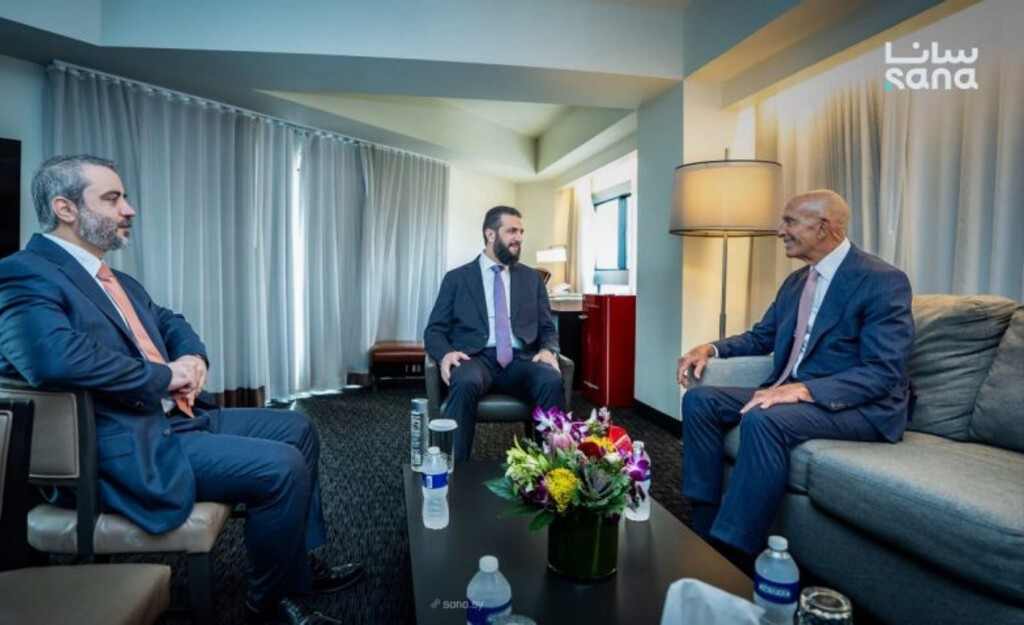
 Syrian President Ahmad al-Sharaa meets with U.S. envoy Thomas Barrack in New York on the sidelines of the UN General Assembly in September 2026, with Foreign Minister Asaad al-Shaibani in attendance. Photo: SANA.
One need only see how al-Jolani’s authorities and their paid mouthpieces seize upon Thomas Barrack’s statements as though they were holy scripture to grasp the extent of their political opportunism. This broker appears to have turned American diplomacy into an exercise in tailoring positions to suit its partners: condemning victims, handing killers certificates of good conduct, and then leaving hired pens to turn his statements into theories and interpretations, as though Barrack were America, and America were Barrack!
U.S. envoy Thomas Barrack speaks about the Druze community in Syria’s Suwayda province.
Nor is it surprising that he should target the Druze with sweeping generalizations and accusations. They have become a thorn in the side of al-Jolani’s bloody project after thwarting its implementation in Suwayda. Sweeping accusations against an entire community are no innocent matter: they divert attention from atrocities committed against civilians and move the victims from demanding justice to standing in the dock.
As for Turkey, Qatar, and al-Jolani’s authorities, Barrack appears to know how to address each party in terms that suit its calculations: giving Ankara what serves its interests, providing Doha with room to maneuver, and placing political and media ammunition in al-Jolani’s hands. The propaganda machine then turns the words of an American envoy into something resembling an official decision binding on Washington, even when those words have not been shown to reflect the position of its institutions. Herein lies the ploy: al-Jolani does not need a genuine American mandate; a statement from Barrack is enough for the propaganda machine to manufacture borrowed legitimacy.
“Al-Jolani does not need a genuine American mandate; a statement from Barrack is enough for the propaganda machine to manufacture borrowed legitimacy.”
Dr. Yahya Alaridi
Anyone seeking to understand the function of these statements should watch what happens to them once they are issued: how they are cherry-picked, amplified, and stripped of context, then presented as sacred authority to silence dissenters and justify accusations against the Druze, while contradictory facts and evidence are pushed aside. At that point, we are no longer witnessing serious debate, but blatant political exploitation.
The irony is that Barrack, instead of strengthening the credibility of American diplomacy, may end up undermining his country’s interests: weakening local communities’ trust in Washington, strengthening anti-American propaganda, and giving a controversial authority cover to market itself internationally. Does he realize that his words may be used against the interests he is supposed to represent, or has appeasing the parties that capitalize on his statements become more important than the credibility of the state on whose behalf he speaks?
“The problem is not that an American envoy speaks, but that his words become a propaganda weapon against the Druze and are sold as an American judgment on an entire community.”
Dr. Yahya Alaridi
The standard is neither what Barrack says about himself nor what al-Jolani proclaims about his relationship with Washington. The standard is the facts, the official positions of American institutions, and the effects these statements have on the ground. Al-Jolani’s treatment of Barrack’s words as holy scripture does not make them absolute truth; it exposes his need to borrow American legitimacy to provide cover for his narrative.
The problem is not that an American envoy speaks, but that his words become a propaganda weapon against the Druze and are sold as an American judgment on an entire community. Policymakers in Washington must ask themselves: Do these statements serve the interests of the United States, or do they give al-Jolani’s authorities political cover and open the door to a partnership with jihadist forces that have long regarded Washington as an enemy?

