
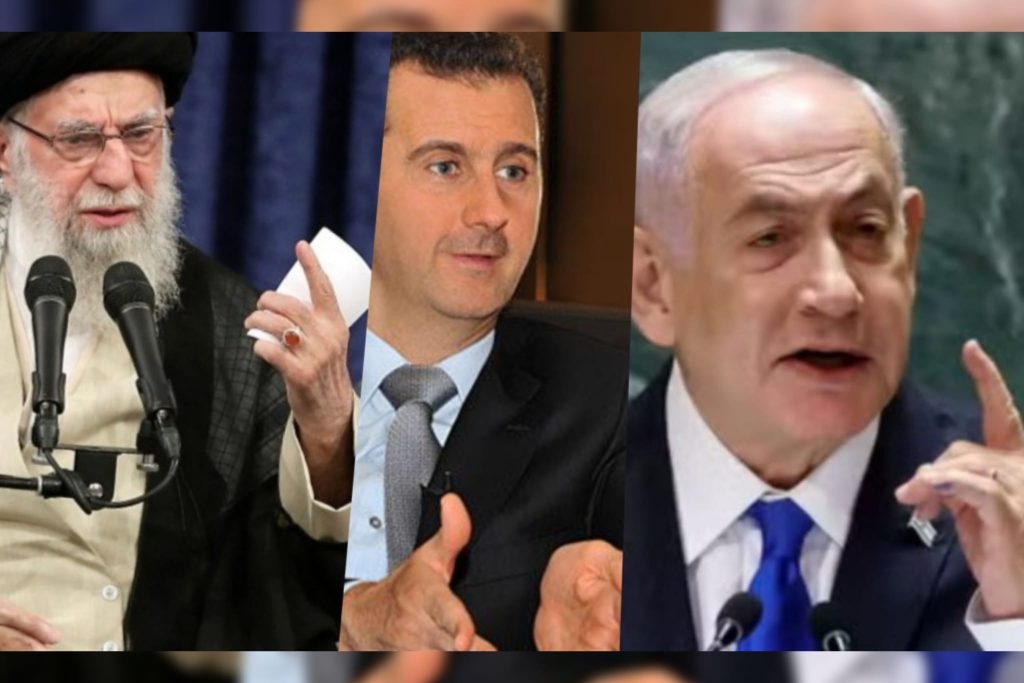
While ground battles rage in southern Lebanon, the eyes of Hezbollah, Israel and Iran remain focused on Syrian territory due to its importance to the future of this war. Understanding why requires a military and geopolitical view of the Syrian arena from the perspective of the war in Lebanon.
Israel is well aware of the importance of closing the Syrian border with Lebanon if they hope to succeed in the ground incursion into the south and destroy Hezbollah’s capabilities. That is why we have witnessed major airstrikes targeting border crossings and roads linking the two countries in addition to raids against Hezbollah sites inside Syria near the border with Lebanon, (including tunnels used in arms smuggling operations). But realistically we are talking about a long border of approximately 375 km linking the two countries, which makes monitoring the entire border line and preventing arms smuggling impossible through air operations. That is why Israel may be moving towards pushing Damascus to adopt a political decision to close the border. But is this even possible?
Assad also knows very well that Israel today is very serious in its decision to limit Iranian influence in the Middle East, and any person or party that stands in the way of this decision would most likely meet with the same fate as Nasrallah
In my opinion, Assad, who has adopted the neutralization of the Golan front from the escalation in Gaza and Lebanon, will not be able to make the decision to close the border with Lebanon at the present time. Until now, Tehran has not practically asked him to allow attacks towards northern Israel from Syrian territory, based upon an understanding with Damascus and Moscow. However, Abbas Araghchi’s recent visit to Damascus carried a clear message from the Iranian leadership that the Assad regime must keep the route of arms shipments heading to Hezbollah in Lebanon open, no matter the cost.
Here lies the dilemma for Assad, for, on the one hand, he is not prepared to anger the Iranians who are the reason for his remaining in power and are capable of making him pay a heavy price if he betrays them. What happened to the former Yemeni president Ali Abdullah Saleh is a sufficient example. On the other hand, Assad also knows very well that Israel today is very serious in its decision to limit Iranian influence in the Middle East, and any person or party that stands in the way of this decision would most likely meet with the same fate as Nasrallah.
Stuck between the proverbial rock and a hard place, literally between Iran and Israel, Assad will turn to Moscow hoping that they will find him a way out of this predicament
Recently Sky News Arabia quoted Syrian sources as saying that the Assad regime had confiscated weapons warehouses belonging to Hezbollah militia in the Damascus countryside. However, a security source refuted this news to me. This is nothing more than a media move by the Assad regime in an effort to give the impression that it has begun to deal seriously with Israeli demands. It is likely that we will hear more of this type of fabricated news that the Assad regime will push to have published.
Stuck between the proverbial rock and a hard place, literally between Iran and Israel, Assad will turn to Moscow hoping that they will find him a way out of this predicament; either that Tehran will take Assad’s situation and the weakness of his regime into consideration along with the fact that he may personally be in danger, or that Moscow will work to find a solution that satisfies the Israeli side or at least that Netanyahu’s government will understand that Assad is unable to close the border with Lebanon in the face of Iran and its militias.
In conclusion, Iran is moving in Lebanon to turn the south into an arena of attrition for the IDF, and to obstruct the Israeli government’s plans to limit Iranian influence in the Middle East. For this plan to succeed, Damascus must keep its borders with Lebanon open at all costs. In Israel, they know very well that keeping the Syrian-Lebanese border open will mean that the fighting in southern Lebanon will shift from fighting Radwan Units, to Iraqi, Afghani and Syrian militias. Therefore, Israel may be forced to deal with Assad in such a way that makes him fully aware of their seriousness.
